Monday, 22 July 2013

The Welsh Crucible

This year I applied for a place on the Welsh Crucible, and my application was accepted. The Welsh Crucible is a yearly scheme for researchers in Wales. It takes 30 researchers from different institutions and different disciplines and puts us all together for 3 workshops ("labs") over the summer, to see what interesting ideas and collaborations can be forged.

So I'm now talking about grant applications to a plant biologist in Cardiff, an environmental chemist in Bangor and a physical geographer in Aberystwyth, and I have a new network of future collaborators spanning a huge range of subjects.

Here are a few other thoughts about the experience, in no particular order:

It's a fantastic networking opportunity, a great way to make contacts for subjects outside your immediate area.

Over the course of the 3 labs I became better at introducing my research in a short and presentable manner. At the start I found this very difficult. At the end it's still hard, but I'm making progress. As a researcher I often feel that I can't really describe my research, full of its day-to-day technical details, in a way that anyone else will understand. One of the exercises they asked us to do was to write 100 words about our research, for a lay person. Another was speed-networking (just 3 minutes per person and then move on). My description of my work still varies, depending on who I'm talking to, but I'm much more happy to attempt it now. Doing these exercises not only helps us communicate with other researchers, but also makes us introspect and see if we're actually doing what we want to be doing.

Speed networking
Speed networking. Photo by Keith Morris.

The best interdisciplinary work is likely to come from a real working friendship where we already trust each other. So build these, and the rest will follow. The Crucible has actually made me take more of an interest in other disciplines and it allows me to feel that it is okay to do so. It's good to be interested in other disciplines, even if the REF assessment says otherwise. In fact its generally made me think about the longer term, about putting good foundations in place and not worrying about short term measurements, and individual wins and losses. From Crucible people I've learned about gallium teaspoons, arthritis inflammation and bone chomping, the placebo effect, dating rocks by luminescence under big black sheets, Jews in Scotland, and the problems of conducting health studies across populations of people.  I'll definitely go to more seminars from other departments now. And maybe I'll wander into some other departments' coffee rooms too...

The wants and offers wall
The wants and offers wall. Photo by Keith Morris.
We were asked to start off by introducing ourselves with a 9-slide pecha kucha presentation. Far more of the male participants than the female participants included a picture of their children in this introduction (about 8/19 male vs about 0/11 female).

Several of the Crucible participants were promoted or took on new positions of responsibility between lab two and lab three. One participant described it as a useful benchmarking experience. We look at others around us and see what can be achieved. 

We have some very talented and enthusiastic researchers across Wales. As a group, we cover a lot of research expertise, and we have the whole range of skills (people management, media engagement, conference organising, book writing, schools outreach, grant writing, presenting, teaching, etc). I look forward to meeting everyone again at the reunion.

All the 2013 Crucible attendees
All the Crucible 2013 attendees. Photo by Keith Morris.

Friday, 7 June 2013

Review: To Kill a Machine

This is the first time I've ever reviewed a play. But it seems appropriate to post this on the anniversary of Turing's death. 


To Kill a Machine by Catrin Fflur Huws and Scriptopgraphy Productions 

Alan Turing had a fascinating life and many people in the UK will know something about him. Perhaps you'll know about his amazing code-breaking work in the war, perhaps you'll know about the mysterious circumstances surrounding his death, or perhaps you'll know that he is one of the founders of computer science. But Turing was a genius, and we don't yet know enough about all the other great things he achieved. Breaking the Enigma code and creating the computer were just two of his accomplishments, and this play takes us through another aspect of his work and his life: his contributions to philosophy and Artificial Intelligence.

We might all agree that a rock shows no signs of intelligence, and that a human does possess intelligence, but in between there's a large grey area. Is a sheep intelligent? Is a city intelligent? Is a machine intelligent? And what is a machine anyway?

Catrin Fflur Hughes has devised a play that weaves together multiple themes in order to explore these ideas. She begins with the difference between a man and a women, a contrast which was more pronounced in the society of Turing's time, where assumptions about gender roles dictated the jobs you might aspire to, and your role in the war. From this she neatly moves on to ask what's the difference between a man and a machine? Are some people more like a machine than a man? And if understanding the difference in intelligence is difficult, then what about in love? What's the difference between loving a man and loving a woman? What happens when we can no longer distinguish these differences and when our lives might depend on it? As the play moves swiftly on, we feel enlightened, and at the same time perplexed: how can we not have considered the relationships between all of these things before?

This play has been written by a playwright who really understood what Alan Turing actually did, and wants to tell us all how ground-breaking that was, and how much it matters to all of us. It will appeal to scientists, who love to see their heroes portrayed in a way that everyone can understand. This is not just a classic and tragic story of love and betrayal, but contains cleverness and computing to keep the geeks happy too. And the acting was superb. Gwydion Rhys gives us a vulnerable hero that we'd like to protect.

As a computer scientist, I feel that this is a hugely important play. It promotes a British scientist whose work should be more widely celebrated and understood, and it was conceived in the centennial year, 100 years after Alan Turing's birth. Mixing the arts and science to create works like this is something we should all be doing more to encourage. We should make plays about science, and use the arts to tell us about great ideas. The world shouldn't be divided into science and arts (or men and women, or men and machines) and Turing didn't make such divisions. The playground between the two is where the best ideas are born.

Go and see this play, and you'll come away feeling inspired to follow in Alan Turing's footsteps. After seeing this, you'll want to be free to be a bit different, think great thoughts and create new ideas.

NLW digitised newspapers

Some fascinating stories are available in the newly digitised newspapers (from 1844 to 1910) from the National Library of Wales collection of Welsh Newspapers.

"The railway officials shouted to her to lay down, which she did just as the train reached her."

Friday, 5 April 2013

Ada Lovelace Colloquium 2013

Dr Julie Greensmith introduces the 2013 Lovelace Colloquium in Nottingham
Yesterday I attended the 2013 Lovelace Colloquium. This a conference aimed at women undergraduates and MSc students in computing, and judging by the quality of the posters made by the attendees we certainly have a lot of fantastic women computing undergraduates in the UK.

When I was at school I was the only female in all of my A-level classes except Computing, where I was one of 2. On my undergrad degree, there was one other woman in my year group. I ended up deliberately joining an aerobics class in an attempt to meet other women. Throughout my computing career, women have been in a substantial minority. So how refreshing it is to go to Lovelace, and find so many enthusiastic technical women, all in one place. And how amazing it is that they are undergraduates, and will be going on to do great things in the future.

The conference is sponsored by several companies and organisations (Google, FDM, CA, EMC, HEA) who all recognise the opportunity of chatting to these students, and want to suggest their companies as career options. 

There were talks about ontologies, careers, artificial immune systems, computer vision and what it's like to work as a developer at Google. And there were plenty of networking opportunities, and the students clearly made the most of them. The support is good too - for example, when one student described her poor industrial year experience with a company that gave her secretarial work while the male placement students got the technical work, the whole audience was able to reassure her that this wasn't normal or right and she shouldn't let it put her off trying again for a computing career. But the highlight of the day is the poster session, which is where the students get to show off their work and enthusiasm, and win prizes of up to £500.

If you haven't yet been to this conference, as a student, an IT professional, an academic member of staff, a self employed consultant, or someone thinking about changing their career to computing, then I can't recommend it highly enough. The positive feeling you get from being part of it is huge.

See also blog posts by:

Monday, 25 March 2013

The genome game


We've made an HTML5/Javascript educational game for teaching children about bioinformatics. You can try out the game on our webserver, or download it, fork it and develop it for your own purposes.

The idea is that we have 4 binary digits controlling 4 aspects of a cute creature's phenotype (eye colour, head colour, body colour and number of legs). The binary digits are big clickable buttons, which toggle the bit value and correspondingly change the creature. We can use this initial button-clicking exercise to talk about combinatorics and binary numbers: how many different creatures can be made by changes to 4 bits?

Then we show the underlying rules. These are the equivalent of "if-then-else" rules, defining how the bit values control the phenotype. The rules can be changed, so the children can choose which bit controls which characteristic, and also choose colours and leg numbers.

The genome game at National Science Week

Finally we can "Make population". This creates a random population of 5 creatures, all generated from the current set of rules, and it hides the rules. Now the game is to have a friend who didn't see the rules guess what the underlying rules were. They can see the 5 creatures and the genomes of each creature. Sometimes it's easy to work out the rules, and sometimes the rules can't be completely determined. It depends on the random 5 creatures. Sometimes all the creatures with blue eyes also happen to have 6 legs, and then we just can't tell which of the 4 bits is responsible for which characteristic.

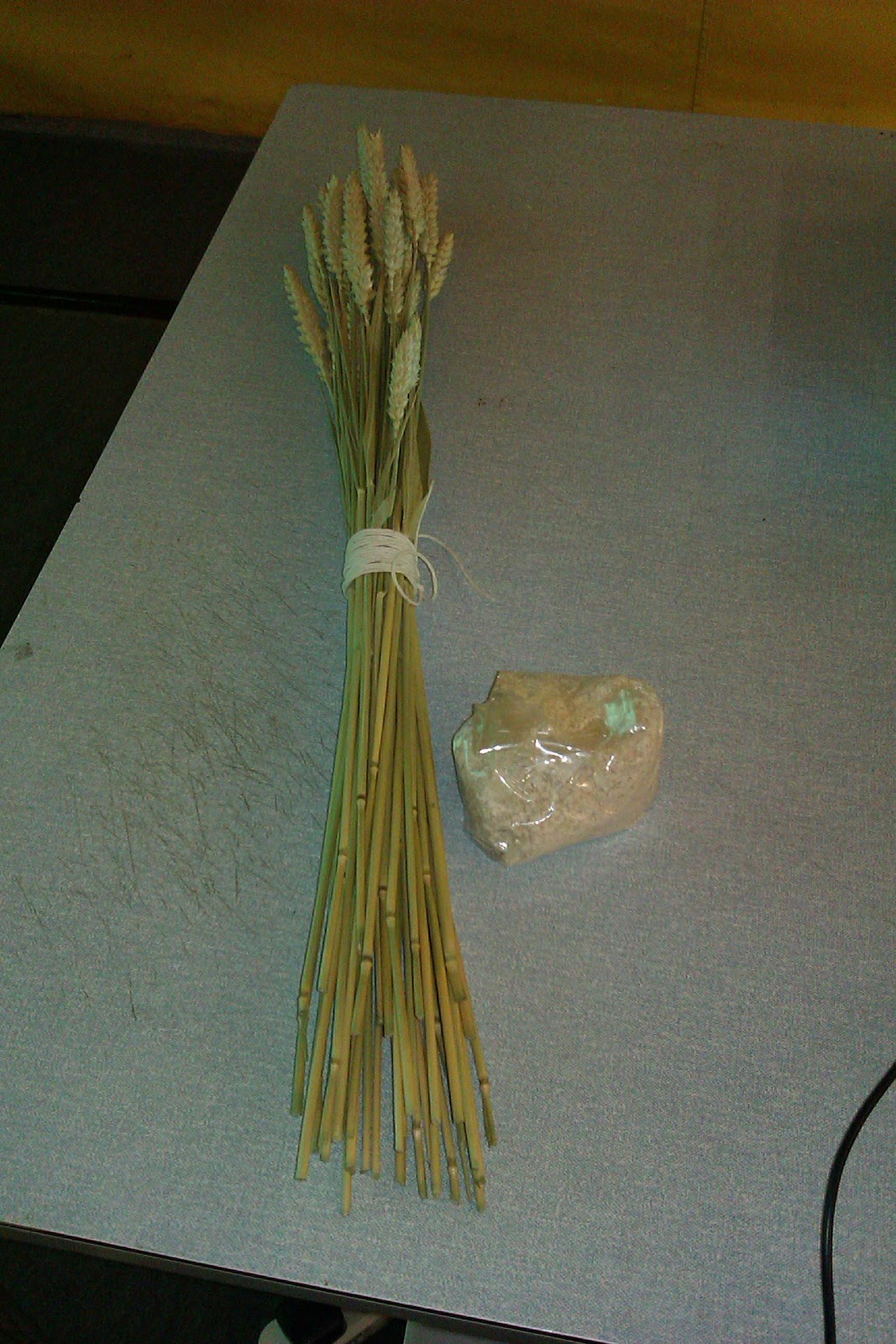
We finish up the discussion by asking how many genes the children think are in baker's yeast (approx 6,000, easy to get hold of a bag of yeast, and they can guess what it is and what it does). They'd guess at "1? 2? 4? millions?" After this we asked them to guess how many genes in a human (approx 20,000). And describe how about 16 genes are actually responsible for your eye colour, not just one. And finally, ask how many genes in wheat (current estimate approx 100,000 or more). The look of astonishment at the complexity of wheat was a common reaction, quickly followed by "Why?". So we tell them that's what scientists are currently trying to find out: what do all our genes or the genes in yeast or wheat actually do? How many representatives of a population would scientists need to determine what the 100,000 genes in wheat do? And we tell them that if they want to work in bioinformatics when they grow up, then they could find out the answers for themselves.

Wheat and yeast: how many genes do they have?

How did this game come about? We have a BBSRC funded project on the application of multi-relational data mining to the problem of finding which parts of an organism's genotype are responsible for its phenotype. This problem is often called GWAS (genome wide association studies) or marker-assisted selective breeding. As part of the application for funding, we said that we'd do some public outreach activities, making a bioinformatics game for children that could be used as part of the Technocamps activities, and represented the research problem that we were working on. The game is obviously a highly simplified view of the research, but still does give an idea of how hard the problem is!

Monday, 12 November 2012

Alfred Henry Allen, an extraordinary chemist

My parents have just written a fantastic paper about A. H. Allen, Sheffield's first Public Analyst. Alfred Henry Allen lived from 1846 to 1904, in a time of gas lamps, horse drawn carriages and dubious Victorian era water quality. His chemical investigations and new methods of analysis shone a light on the practices of careless or unscrupulous food and drink manufacturers.

The paper describes lots of his achievements. For example he investigated why the drinking water in some areas of Sheffield contained harmful lead, which was poisoning the population, while other areas had lead-free water (it turns out that the leaded water came from reservoirs which were found to be acidic, and the acid dissolved some of the lead from pipework, so he proposed that the water be treated with lime and limestone to remove the acidity).

Allen investigated the proportions and effects of the different alcohols found in whisky, and even did some testing on himself, drinking a wine glass full of whisky every evening for 3 weeks in order to show that amyl alcohols did no harm. You'll also want to read about his concerns about the "slovenly and ignorant" production of cider, where the cider makers reused manure carts to carry apples.

He didn't just do the science, but also communicated it to a wider audience. He gave public talks and "entertainments", such as Alchemy and the Alchemist, Chemistry of ExplosivesVisible Sound, and Artificial Light. The paper points out that "People in Victorian times had a thirst for entertainment of a scientific and paranormal nature", and I imagine his lectures would have been very popular. Would his talk on Chemistry of Explosives have featured exciting demonstrations that would be impossible today for health and safety reasons? What magic would the lecture on Alchemy have shown?

Allen published over 150 papers and many books on methods of chemical analysis. He wrote 13 volumes of a book called "Commercial Organic Analysis", which needed continual updating as science progressed. He was a founder member of the Society of Public Analysts. He died of diabetes, a disease that had no cure or effective treatment at the time (though Allen had published papers, a book and chemical analysis methods for the determination of sugars in urine, so he would have been well able to measure his condition). During his life, he developed a business of consulting chemists (A.H. Allen & Partners), at which, after many years, my parents worked, and they have now honoured him by documenting his place in history.

Friday, 17 August 2012

Turing sunflowers are beginning to flower

0 has opened her flower. 1 broke in the wind and had to be replaced, but now she's catching up.


And 0 and 1 now have a sister sunflower: 10, who is leaning a little, losing her petals, and starting to set seeds.

Looking forward to counting!