Friday, 5 April 2013

Ada Lovelace Colloquium 2013

Dr Julie Greensmith introduces the 2013 Lovelace Colloquium in Nottingham
Yesterday I attended the 2013 Lovelace Colloquium. This a conference aimed at women undergraduates and MSc students in computing, and judging by the quality of the posters made by the attendees we certainly have a lot of fantastic women computing undergraduates in the UK.

When I was at school I was the only female in all of my A-level classes except Computing, where I was one of 2. On my undergrad degree, there was one other woman in my year group. I ended up deliberately joining an aerobics class in an attempt to meet other women. Throughout my computing career, women have been in a substantial minority. So how refreshing it is to go to Lovelace, and find so many enthusiastic technical women, all in one place. And how amazing it is that they are undergraduates, and will be going on to do great things in the future.

The conference is sponsored by several companies and organisations (Google, FDM, CA, EMC, HEA) who all recognise the opportunity of chatting to these students, and want to suggest their companies as career options. 

There were talks about ontologies, careers, artificial immune systems, computer vision and what it's like to work as a developer at Google. And there were plenty of networking opportunities, and the students clearly made the most of them. The support is good too - for example, when one student described her poor industrial year experience with a company that gave her secretarial work while the male placement students got the technical work, the whole audience was able to reassure her that this wasn't normal or right and she shouldn't let it put her off trying again for a computing career. But the highlight of the day is the poster session, which is where the students get to show off their work and enthusiasm, and win prizes of up to £500.

If you haven't yet been to this conference, as a student, an IT professional, an academic member of staff, a self employed consultant, or someone thinking about changing their career to computing, then I can't recommend it highly enough. The positive feeling you get from being part of it is huge.

See also blog posts by:

Monday, 25 March 2013

The genome game


We've made an HTML5/Javascript educational game for teaching children about bioinformatics. You can try out the game on our webserver, or download it, fork it and develop it for your own purposes.

The idea is that we have 4 binary digits controlling 4 aspects of a cute creature's phenotype (eye colour, head colour, body colour and number of legs). The binary digits are big clickable buttons, which toggle the bit value and correspondingly change the creature. We can use this initial button-clicking exercise to talk about combinatorics and binary numbers: how many different creatures can be made by changes to 4 bits?

Then we show the underlying rules. These are the equivalent of "if-then-else" rules, defining how the bit values control the phenotype. The rules can be changed, so the children can choose which bit controls which characteristic, and also choose colours and leg numbers.

The genome game at National Science Week

Finally we can "Make population". This creates a random population of 5 creatures, all generated from the current set of rules, and it hides the rules. Now the game is to have a friend who didn't see the rules guess what the underlying rules were. They can see the 5 creatures and the genomes of each creature. Sometimes it's easy to work out the rules, and sometimes the rules can't be completely determined. It depends on the random 5 creatures. Sometimes all the creatures with blue eyes also happen to have 6 legs, and then we just can't tell which of the 4 bits is responsible for which characteristic.

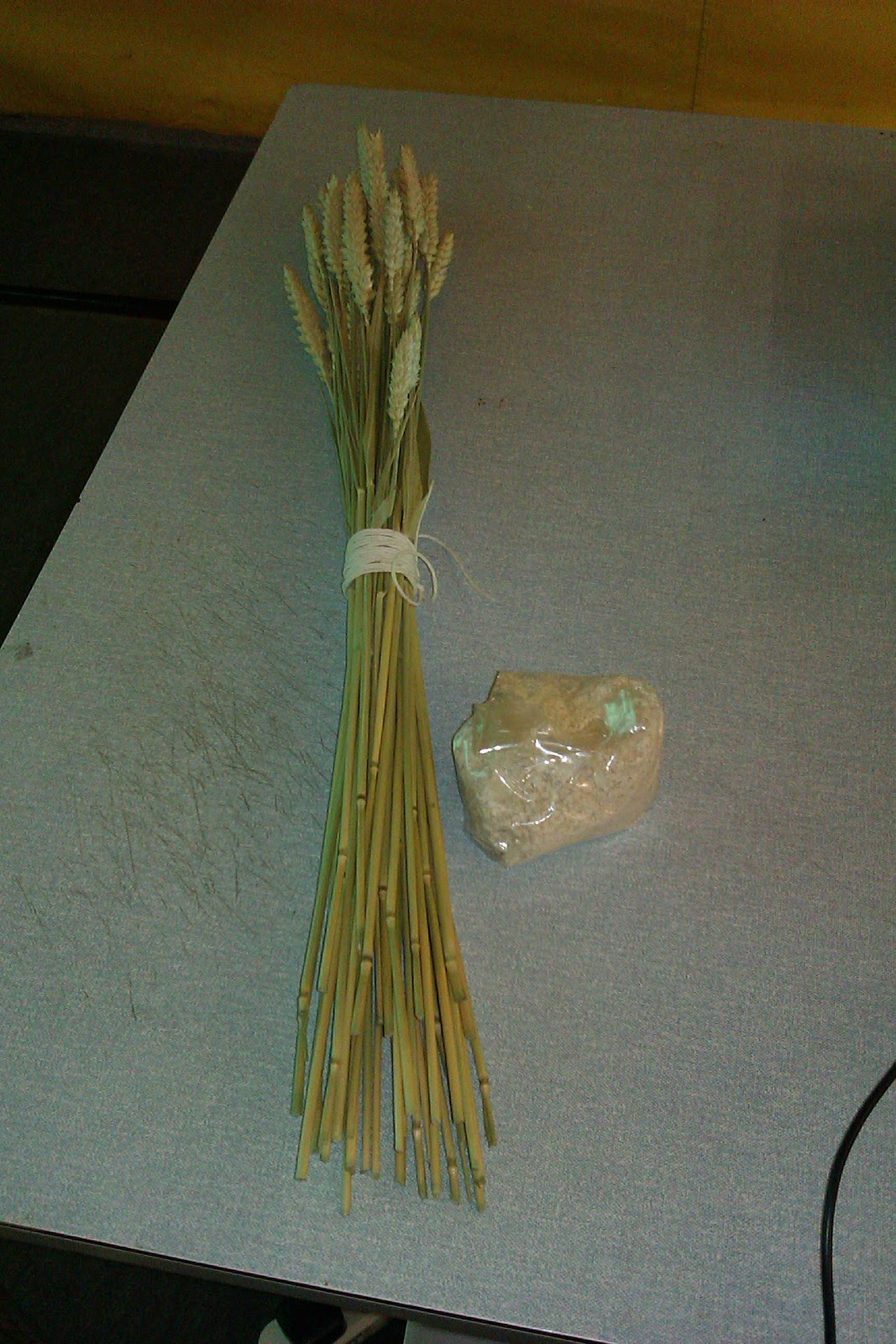
We finish up the discussion by asking how many genes the children think are in baker's yeast (approx 6,000, easy to get hold of a bag of yeast, and they can guess what it is and what it does). They'd guess at "1? 2? 4? millions?" After this we asked them to guess how many genes in a human (approx 20,000). And describe how about 16 genes are actually responsible for your eye colour, not just one. And finally, ask how many genes in wheat (current estimate approx 100,000 or more). The look of astonishment at the complexity of wheat was a common reaction, quickly followed by "Why?". So we tell them that's what scientists are currently trying to find out: what do all our genes or the genes in yeast or wheat actually do? How many representatives of a population would scientists need to determine what the 100,000 genes in wheat do? And we tell them that if they want to work in bioinformatics when they grow up, then they could find out the answers for themselves.

Wheat and yeast: how many genes do they have?

How did this game come about? We have a BBSRC funded project on the application of multi-relational data mining to the problem of finding which parts of an organism's genotype are responsible for its phenotype. This problem is often called GWAS (genome wide association studies) or marker-assisted selective breeding. As part of the application for funding, we said that we'd do some public outreach activities, making a bioinformatics game for children that could be used as part of the Technocamps activities, and represented the research problem that we were working on. The game is obviously a highly simplified view of the research, but still does give an idea of how hard the problem is!

Monday, 12 November 2012

Alfred Henry Allen, an extraordinary chemist

My parents have just written a fantastic paper about A. H. Allen, Sheffield's first Public Analyst. Alfred Henry Allen lived from 1846 to 1904, in a time of gas lamps, horse drawn carriages and dubious Victorian era water quality. His chemical investigations and new methods of analysis shone a light on the practices of careless or unscrupulous food and drink manufacturers.

The paper describes lots of his achievements. For example he investigated why the drinking water in some areas of Sheffield contained harmful lead, which was poisoning the population, while other areas had lead-free water (it turns out that the leaded water came from reservoirs which were found to be acidic, and the acid dissolved some of the lead from pipework, so he proposed that the water be treated with lime and limestone to remove the acidity).

Allen investigated the proportions and effects of the different alcohols found in whisky, and even did some testing on himself, drinking a wine glass full of whisky every evening for 3 weeks in order to show that amyl alcohols did no harm. You'll also want to read about his concerns about the "slovenly and ignorant" production of cider, where the cider makers reused manure carts to carry apples.

He didn't just do the science, but also communicated it to a wider audience. He gave public talks and "entertainments", such as Alchemy and the Alchemist, Chemistry of Explosives, Visible Sound, and Artificial Light. The paper points out that "People in Victorian times had a thirst for entertainment of a scientific and paranormal nature", and I imagine his lectures would have been very popular. Would his talk on Chemistry of Explosives have featured exciting demonstrations that would be impossible today for health and safety reasons? What magic would the lecture on Alchemy have shown?

Allen published over 150 papers and many books on methods of chemical analysis. He wrote 13 volumes of a book called "Commercial Organic Analysis", which needed continual updating as science progressed. He was a founder member of the Society of Public Analysts. He died of diabetes, a disease that had no cure or effective treatment at the time (though Allen had published papers, a book and chemical analysis methods for the determination of sugars in urine, so he would have been well able to measure his condition). During his life, he developed a business of consulting chemists (A.H. Allen & Partners), at which, after many years, my parents worked, and they have now honoured him by documenting his place in history.

Friday, 17 August 2012

Turing sunflowers are beginning to flower

0 has opened her flower. 1 broke in the wind and had to be replaced, but now she's catching up.


And 0 and 1 now have a sister sunflower: 10, who is leaning a little, losing her petals, and starting to set seeds.

Looking forward to counting!


Science galleries

There is a growing awareness that scientists and engineers should be better at communicating their work to the public (and to policy makers). It's not enough just to do good science if no one knows about it.

The excellent Sixty Symbols project has scientists at Nottingham Uni making videos about interesting aspects of physics and astronomy. There are Science Cafes (or Cafe Scientifiques) around the country to chat about science in a mixed audience. As part of our current research project we're going to make an online bioinformatics activity that can be used in schools to teach children about binary numbers, rules and about how genome translates into phenotype. BCS Mid-Wales have recently had two successful show-and-tell events where robots, games, and technology were proudly shown and enjoyed. And we've just had a student develop a fantastic HTML5/Javascript game to demonstrate evolution in partially selfing fish populations (you have to breed a bigger population than your competitors and not get infected).

In every reasonably-sized town there will an art gallery (where the public can go to see art), a museum (where the public can learn about history), and a library (where the public can go to find literature). is there an equivalent for science? There are science museums/education centres in certain towns, but they aren't as widespread as art galleries/museums/libraries by a long way. And they're often aimed at educating children and teenagers rather than aiming at inspiring adults. Art galleries are rarely aimed at children and teenagers.

Here in Aberystwyth we have an Arts Centre with multiple galleries where I can see stunning photography, paintings and prints, Ceredigion museum which shows me what amazing outfits people used to wear when bathing, and how huge telephone cables used to be, and we have more libraries than most towns, including the university libraries, a town library and the National Library of Wales. But we don't have a place I can go on a rainy Saturday afternoon to browse science. I can read about science in the library, but that's not the same thing. I'd like to see Science Galleries in every town.

Tuesday, 26 June 2012

Day 1 of The Alan Turing Centenary Conference in Manchester

I've been attending the Alan Turing Centenary Conference in Manchester. The conference was in the huge and beautiful Manchester Town Hall, and it feels very appropriate to hear these talks in Manchester where Turing worked. The conference was over a weekend, including Saturday 23rd June, which was Turing's birthday 100 years ago. There were too many talks to write about all of them, but here are a few comments on a few of the talks from Day 1.

Vint Cerf is Chief Internet Evangelist for Google, one of the creators of the internet and of TCP/IP. He described the early days of the internet, how they had to make decisions about the size of the address space they would need in order to address each of the devices connected to the internet. Imagine their problem in the 70s, trying to work out how many computers there would be in the future. Now there are about 2-3 billion internet devices connected at any one time, and a load more devices only intermittently connected. Everything is now becoming networked, including Cerf's wine cellar, which of course has a sensor network measuring temperature, humidity and light conditions, and will send an alert to his mobile phone if his wine becomes too warm. See Vint Cerf's talk.

Yuri Matiyasevich talked about number theory, which was yet another of Turing's many fields of work. Turing wrote a few papers in number theory, looking at the Riemann hypothesis. During telling us about the Riemann hypothesis, Matiyasevich told us about Skewes number, "the largest number that served any definite purpose in mathematics" according to Hardy, which was a massive lower bound of 10^10^10^34. In 1939, Turing applied for a grant from the Royal Society for just £40 to calculate information about zeros in the Riemann zeta function. This rather small amount of money was to buy parts in order to adapt some machines for predicting tides to the purpose he had in mind. Matiyasevich showed a picture of a tide prediction machine, and it instantly gives an impression of the "technology" that Turing was working with at the time. Apparently, Turing was fine with the fact that his machine gave its output in base 32, stating that he was "sufficiently familiar" with reading numbers in this form that it wasn't a problem. See Yuri Matiyasevich's talk.

David Ferrucci is the main man behind the Watson system that beat humans at the American quiz game 'Jeopardy' talked about the creation of Watson. Although Jeopardy isn't a Turing test, it is a test of general knowledge, and in this case a machine was competing against humans. His team of about 20 people put together many components (parsers, entity and relation extraction, knowledge base and search techniques etc) and then tested the system as a whole as the primary metric, not any one component. Initially it took 2 hours to answer a question, and some serious parallelisation of tasks was needed to make it fast enough for the game show. He gave lots of examples of questions and answers in his talk, including a question that asked for the common theme between "shirt", "telephone" and "TV remote control", to which the answer was "buttons", though "made with petrochemicals" and "made by humans" were also valid answers suggested by Watson. See David Ferrucci's talk.

Fred Brooks talked about Turing's Pilot ACE, a prototype of the ACE computer that Turing designed and wanted to build. Why did Turing's computer not take off? He suggested 3 main reasons: that he didn't publish his 1945 proposal, the machine was too late by the time it finally got built, and he didn't make it easy to program (didn't foresee how important that would be). Again we get the impression of Turing's amazing ability with numbers. Using backwards binary with the lower order bits on the left was no problem to him, but was not so easy for others. ACE also had other peculiarities: no accumulator, no general multiply, no straightforward conditional branch. Brooks recommended a new book by Simon Lavington, "Alan Turing and his contemporaries: Building the world's first computer", and he recommended everyone read von Neumann's EDVAC report on a much more practical machine. You can now see the Pilot ACE in the Science Museum in London. See Fred Brooks' talk.

The conference even after day 1 was already giving a wonderful picture of how diverse Turing's contributions to computer science and mathematics were, and how far reaching his ideas would be.

See also my writeup of Day 2 and Day 3 of the conference, and the online video recordings of the talks.

Day 2 of the Alan Turing Centenary Conference in Manchester

On the second day of the Turing Centenary Conference in Manchester there were more great talks. The screen showing the presentations was flanked by a large image of Alan Turing, reclining in a chair, reading a book. It was rather like having him present, listening to the talks.

Tony Hoare asked the question "Can computers understand their own programs?" and proceeded to propose to answer it with an alternative to the Turing test. In the same way that "Can a machine be intelligent" cannot be answered without a definition of "intelligent", Hoare's question cannot be answered without a definition of "understand". Instead, if a computer can answer questions posed to it about its own program, and give correct and useful answers, and explain its reasoning, then we may conclude that it understands its program. These questions might be, for example: "Will this change make the program run more slowly". He also finished his talk with a hint at his current work on algebras for programming, by asking whether programming will become part of recognised formal logic in the future. See Tony Hoare's talk.

Manuela Veloso is a robotics researcher who had 116 robots in her lab at a count in 2011. Her talk gave a tour of her work. This included planning and replanning in domains like robot football, purposeful perception (we only see/perceive what we need to deal with the task in hand, and if you arrive at an airport, you won't notice what colour the seats in the lounge are, because you're busy looking for a sign saying "Exit" or "Baggage"), robots that cohabit with humans and ask humans for help, and discussions about whether both robots and humans now use off-board AI. If Veloso and her robots had come to my school when I was young,  I'm sure I would have wanted to be a roboticist immediately. In one visit to a school, a 6-year old asked "Did the robots wonder why you picked them up?"

Donald Knuth gave a pre-dinner speech. This was actually just a short speech followed by question-and-answer session. He said that he was proud to be a geek and he believed that Alan Turing was 100% geek. He handled a wide variety of questions, such as "What advice would you give to a young researcher" (follow your muse), "Are your children and grandchildren programmers?" (my son is a maths teacher, my grandchildren are too young yet to know), "Are objects the same as co-routines (that question was from Bertrand Meyer, the creator of the Eiffel programming language, and the answer was an involved characterisation of their similarities and differences), "Whats your next book" (my life's work is the Art of Computer Programming, I'm working on the new volume, it's slow progress because I want it to be right).

During his short speech, Knuth said that he'd been on Friday before the conference to see the Alan Turing statue in Sackville Gardens, near Manchester Piccadilly. He'd sat there on the bench with Turing's statue, and he and Turing both sat there and thought for about 10 minutes, and he found it wonderful, and he recommended it to us all. When I left the conference on Monday lunchtime, I went via Turing's statue and did the same. The statue is life-size and feels strangely human, especially when you sit on the bench next to him. I'll never get to meet Turing, but I think that attending a 3 day conference all about his work, followed by sitting next to his life-size statue on a bench is probably the next best thing.

See also my writeup of Day 1 and Day 3 of the conference, and the online video recordings of the talks.