I gave this as a very short talk at the recent BCS Mid-Wales Show and Tell. So I'm describing it here in case it's of use to others. The presentation was mostly a collection of rather large photos but it can be downloaded at http://figshare.com/articles/Sewable_Wearable_Computing/1056536. I was inspired to give it a go by Charlotte Godley (@charwarz on Twitter) who ran a wearables workshop for Girl Guides using Adafruit Gemmas. These are small Arduino chips on a mounted on a base, made by a company called Adafruit. The base has holes so that you can sew it onto items of clothing. Slide 2 shows a Gemma attached by crocodile clips to an LED, a light that can be programmed to flash in any colour. The Gemmas are very cheap, only £6.50 so you can safely play with electronics without spending too much if you break it.
Steel thread can be used to sew your Gemma to its LEDs. This conducts and so replaces the crocodile clips (or soldering bits of metal) when you want to make wearable electronics. It's not that easy to sew. It doesn't bend and tie as easily as thread does, and can come undone, and make short circuits when it crosses other bits of thread. Also, the longer the thread, the higher the resistance.
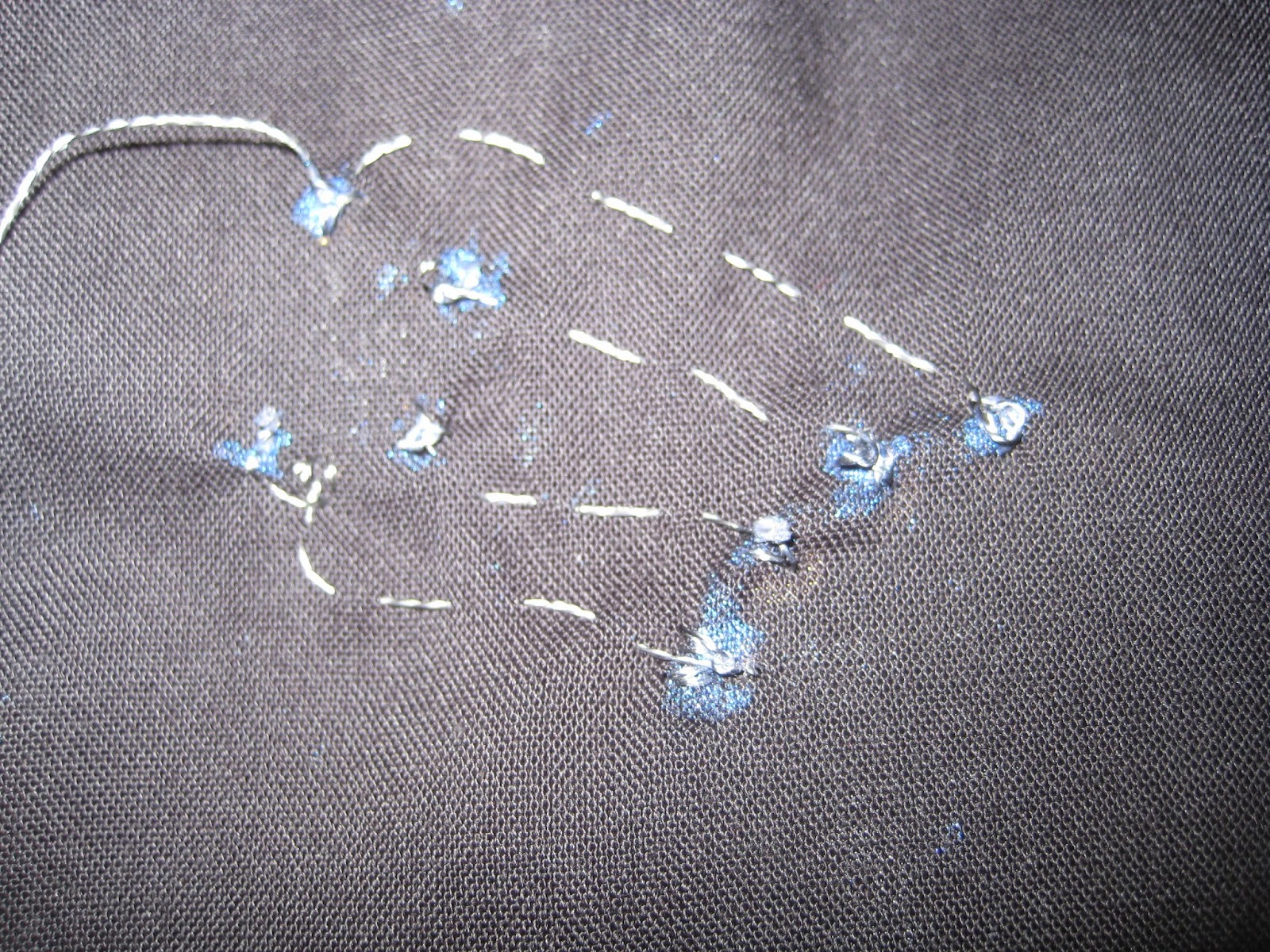
After the Gemma, I got a Flora, it's bigger sister. This costs approx £20, and has more available connections. I wanted to attach an accelerometer and lights, and have the lights flash different colours in order to demonstrate the x, y or z direction of movement. The presentation shows how I put it together and how much it cost. You can see how it was stitched, how I used nail varnish to stop the knots in the ends of the steel thread from unravelling, and how it gets programmed using the Arduino environment.
The Adafruit site has a lot of useful explanations and videos about the Gemma and the Flora. You can buy the equipment from many sites (I used Phenoptix and 4tronix, both were good).
Overall, it was fiddly, but a lot of fun. Computing projects that have an element of real hardware, poor connections, and many parts, each of which could be wrong, are always harder to debug than software. I've never really played with electronics before, and I ended up learning a lot even in this simple project, about power, resistance and circuits. And I now have a thing with flashing lights that I can wear on my leg while dancing the Charleston.
Friday, 13 June 2014
Sunday, 20 April 2014
Lovelace Colloquium 2014
This year I'm not going to write about the fact that the Lovelace Colloquium is for women undergraduates in computer science because I already did this in 2012 and 2013. And I won't write about how much fun it was this year, because Charlotte has already done that.
I'm just going to mention that after the conference, on the way home, changing trains at Birmingham International, I went to browse WHSmiths for something to read on the train.
Yes, the computing magazines are in the section labelled "Mens Lifestyle". Not for us women. We can have interiors, weddings, home and travel. I don't know why even WHSmiths wants to discourage us from computing. Why do they need to separate the magazines by gender instead of by topic anyway?
Then, on the train, I saw a blog post on my twitter feed about the NSF Waterman award, which has been won by men for the last 10 years in a row. All I can hope is that the women undergrads who entered and presented at Lovelace 2014 will now continue to enter many competitions for their work in science, to continue to present their work at conferences, to feel that they can enjoy computer science (whatever our high street shops try to tell us) and to win far more recognition than we do at present.
Update: Also see what Michelle Brown thought of Lovelace 2014.
I'm just going to mention that after the conference, on the way home, changing trains at Birmingham International, I went to browse WHSmiths for something to read on the train.
Yes, the computing magazines are in the section labelled "Mens Lifestyle". Not for us women. We can have interiors, weddings, home and travel. I don't know why even WHSmiths wants to discourage us from computing. Why do they need to separate the magazines by gender instead of by topic anyway?
Then, on the train, I saw a blog post on my twitter feed about the NSF Waterman award, which has been won by men for the last 10 years in a row. All I can hope is that the women undergrads who entered and presented at Lovelace 2014 will now continue to enter many competitions for their work in science, to continue to present their work at conferences, to feel that they can enjoy computer science (whatever our high street shops try to tell us) and to win far more recognition than we do at present.
Update: Also see what Michelle Brown thought of Lovelace 2014.
Monday, 3 March 2014
Western Mail article about bioinformatics
As part of the Welsh Crucible I had an article in the Western Mail today. How computer science can solve problems in biology. We were asked to explain our work in 400-500 words (they chose the title). Much more challenging than I thought it would be, because that's not very many words.
Thursday, 6 February 2014
Final year computer science projects
This term I'm supervising 5 final year student projects. They have one term (just over 3 months) in which to really create something they can be proud of. It's not long, especially when they have to get to grips with new terminology, new equipment, reading and research, specification, design, implementation and experiments, testing, documentation and reflection. They're also asked to keep progress diaries or blogs and use version control to manage their projects.
I've very excited about the projects this year, they're all diverse and fun:
Hopefully, we'll have some good results by May!
I've very excited about the projects this year, they're all diverse and fun:
- Using information theory and machine learning to recognise quality control issues in next gen sequencing lanelets (together with Joshua Randall, Sanger Institute)
- Analysis of the content of NLW's digitised newspapers collection
- Modelling insect choice among plants (together with Lizzy Donkin and John Warren in IBERS)
- A model of the brain of C. elegans that we can play with as a talking point in AI discussions with the public.
- Using image processing and microscope webcams to determine the growth of yeast in microtitre plates.
Hopefully, we'll have some good results by May!
Bioinformatics and computational biology: 500 years of exciting problems?
I gave a talk at Warwick University, Department of Computer Science in January 2014. A look at the intertwining of computer science and biology from the days of Turing through the present and on to the future, including some of my research along the way.
In a 1993 interview, Donald Knuth worried that computer science in the future will be "pretty much working on refinements of well-explored things", whereas "Biology easily has 500 years of exciting problems to work on". I'll describe some of the bioinformatics and computational biology that I've been working on. My talk included a little about where the field has come from, where it's going in the future, and whether it should be considered a branch of computer science at all.
The slides are online at Figshare.
Sunday, 5 January 2014
Storm damage in Aberystwyth in January 2014 and in January 1890
An unusually high tide in Aberystwyth in January 2014 has severely damaged the promenade. We do get some spectacular weather here on the west coast of Wales.
Forceful storms that broke up the promenade also occurred in other years, particularly in 1927 and 1938, and their aftermath was photographed and looks remarkably similar. In January 1890, the Cambrian News reported a storm at Aberystwyth which caused trouble to the train travelling between Aberystwyth and Machynlleth.
"The uptrain from Aberystwyth had to wait in the Junction for over half an hour until the tide had partially subsided. Then the line was cleared of pieces of timber and accumulations of grass and rushes and the train proceeded, though the water was half way up the wheels."
Would the Junction that was referred to here be Dyfi Junction station? The storm in 1890 also caused a hole in the sea wall, in a very similar location to the one that's been opened up this year:
"Unfortunately, the masonry forming the slipway near the Queen's Hotel gave way and subsequently a large hole was washed in the sea wall"
The Queen's Hotel is no longer a hotel, but still exists as a building. It has been used for many purposes since 1890, and has most recently been used as council offices and archives. It's currently up for sale, at a price of approximately £1 million.
The hole in the sea wall caused by this year's weather shows just how powerful the sea is against our buildings and defences.
And in 1890 a steamer in distress was spotted out in the bay, carrying a cargo of pig-iron but having lost its funnel in the storm. The lifeboat was launched, under the command of a Mr Tom Williams, and the crew were rescued and taken to the Belle Vue Hotel for "much-needed refreshments". Our lifeboat was also out rescuing in 2014 and, so far, everyone's safe and sound.
More photos of what happened in 2014 are on Flickr.
Broken railings and paving on Aberystwyth promenade.
Forceful storms that broke up the promenade also occurred in other years, particularly in 1927 and 1938, and their aftermath was photographed and looks remarkably similar. In January 1890, the Cambrian News reported a storm at Aberystwyth which caused trouble to the train travelling between Aberystwyth and Machynlleth.
"The uptrain from Aberystwyth had to wait in the Junction for over half an hour until the tide had partially subsided. Then the line was cleared of pieces of timber and accumulations of grass and rushes and the train proceeded, though the water was half way up the wheels."
Would the Junction that was referred to here be Dyfi Junction station? The storm in 1890 also caused a hole in the sea wall, in a very similar location to the one that's been opened up this year:
"Unfortunately, the masonry forming the slipway near the Queen's Hotel gave way and subsequently a large hole was washed in the sea wall"
The Queen's Hotel is no longer a hotel, but still exists as a building. It has been used for many purposes since 1890, and has most recently been used as council offices and archives. It's currently up for sale, at a price of approximately £1 million.
The hole in the sea wall caused by this year's weather shows just how powerful the sea is against our buildings and defences.
And in 1890 a steamer in distress was spotted out in the bay, carrying a cargo of pig-iron but having lost its funnel in the storm. The lifeboat was launched, under the command of a Mr Tom Williams, and the crew were rescued and taken to the Belle Vue Hotel for "much-needed refreshments". Our lifeboat was also out rescuing in 2014 and, so far, everyone's safe and sound.
Waves wash over the promenade in front of Alexandra Hall and flood the ground floor.
Tuesday, 15 October 2013
My Ada Lovelace post: Donna Robinson
My post for this Ada Lovelace Day is about a woman in computing who inspired me, a friend of mine called Donna Robinson. I first met Donna when living in Guildford, when I was 23. We shared a house (with two other people). She took me shopping for a toolbox (metal, not plastic) and tools (hammers, pliers, mole grips, hacksaw, screwdrivers, and lots more, everything I'd need to be self-sufficient). I didn't have much money. "Trust me", she said, "it's worth investing in good tools". I still have those tools and the toolbox and they're still in use, more than 15 years later.
Donna writes open source code. She made the Oxford College Student Database. She made Valkyrie for Valgrind. She made a library of Scottish Country Dances for the SCDS. She's continually making open source stuff for people, but most of it isn't visible on the web (and neither is she). She financed her open source work by doing up run-down houses in the day, and hacking her code all evening. She chooses not to have an ordinary 9-5 stable job, and it takes a lot of time and effort to do that.
What has most inspired me about Donna is not her coding (though she does that), or her handiness at any manual jobs (though she does that), or her dedication to whatever she chooses to do (see for example how she helped her cat get better after an accident) but her attitude: she knows that with enough time and research she can do whatever she wants to achieve, and she never seemed to have that worry that she wouldn't be taken seriously because she's not male.
Donna writes open source code. She made the Oxford College Student Database. She made Valkyrie for Valgrind. She made a library of Scottish Country Dances for the SCDS. She's continually making open source stuff for people, but most of it isn't visible on the web (and neither is she). She financed her open source work by doing up run-down houses in the day, and hacking her code all evening. She chooses not to have an ordinary 9-5 stable job, and it takes a lot of time and effort to do that.
What has most inspired me about Donna is not her coding (though she does that), or her handiness at any manual jobs (though she does that), or her dedication to whatever she chooses to do (see for example how she helped her cat get better after an accident) but her attitude: she knows that with enough time and research she can do whatever she wants to achieve, and she never seemed to have that worry that she wouldn't be taken seriously because she's not male.
Subscribe to:
Posts (Atom)

